URI-logo
GSO-logo
CRC-logo
Coastal Resources Center
Home | Contact
  • About
    • The Challenge
    • CRC Vision and Approach
    • CRC Values and History
    • Partners
    • Staff
    • Contact Us
  • Topic Areas
    • Fisheries and Aquaculture
    • Climate Change
    • Community Planning
    • Marine Conservation
    • Capacity Development
    • Coastal and Ocean Planning
  • Projects and Activities
  • Locations
    • Global
    • Africa
    • Asia Pacific
    • Latin America & Caribbean
    • United States
    • Rhode Island
  • Publications

Blog Archives

Senegal Makes History with Approval of Sardinella Management Plans

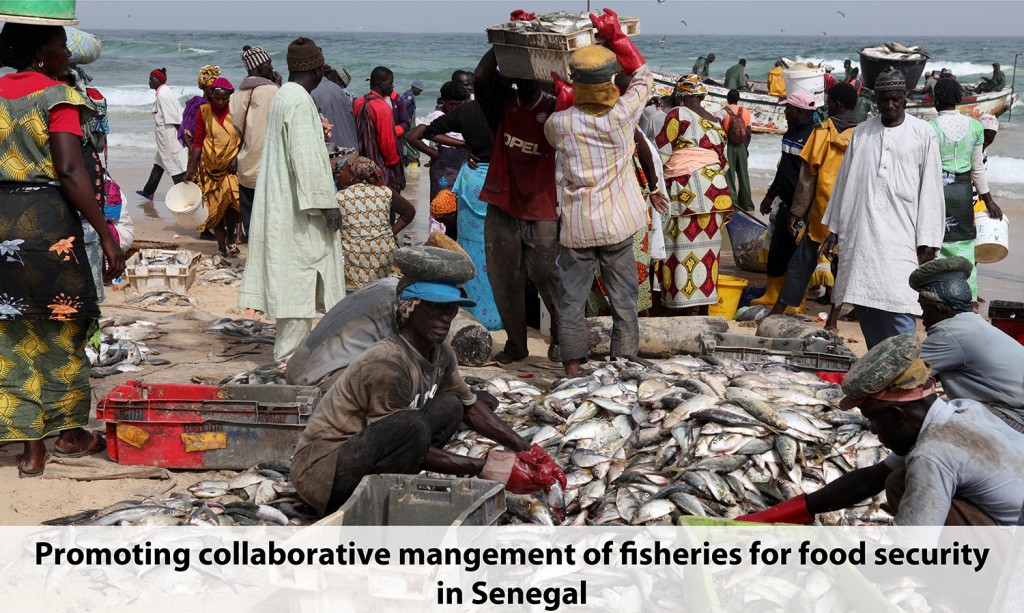
COM11_mgtposterpicTwo years of persistent, participatory work guided by the Coastal Resources Center (CRC) have culminated in a historic approval of fishery management plans in Senegal.

On September 30, the Minister of Fisheries and Maritime Economy signed and formally approved three sardinella collaborative Fishery Management Plans for the fishing zones of the Petite Cote, Grand Cote and Cap Vert. These three zones make up a majority of sardinella landings and represent key supporting management mechanisms to the national sardinella management plan.

The approval is a result of the two-year inclusive, participatory, and capacity building process for fisheries co-management guided by USAID/COMFISH initiative implemented by CRC, which is part of the University of Rhode Island’s Graduate School of Oceanography.

Approval of the plans represents a unique achievement in one of the most important marine fisheries in Africa. Local fisheries governing bodies, known as Local Artisanal Fisheries Councils, have developed and will implement the management plans.These plans and the process for their development have the potential to be a game-changer in Senegal’s fisheries sector and are concrete symbols of the trust and appreciation from partners and beneficiaries for the partnership effort.

Sardinella is a pelagic species of great importance to the Canary Current marine ecosystem. The species alone accounts for over 80 percent of fish landings by artisanal fishers in Senegal, and is one of the main sources of animal protein in Senegal – over 70 percent. The management plans are a boost to long-term food security in the country. They serve the goals of safeguarding livelihoods for communities working in all aspects of sardinella fisheries (including small-scale fish processing), and optimizing revenues produced by fisheries resources while helping keep fisheries stocks in good health.
SAMSUNG CAMERA PICTURES
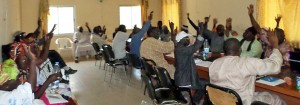
Local fisheries councils take an active part in shaping the sardinella management plans. (Credit: USAID/COMFISH)

USAID/COMFISH (United States Agency for International Development/Collaborative Management for a Sustainable Fisheries Future in Senegal) is working with local fisheries actors and relevant fisheries departments to promote the development of similar participatory plans for other sardinella fishing zones, and to develop collaborative management plans for the estuarine species locally called bonga (a shad species).

USAID/COMFISH is a five-year project funded by USAID to support the collaborative and sustainable management of fisheries in Senegal. CRC implements the project in partnership with national and local actors in Senegal.
Senegal Leads the Way in Climate Change Fisheries’ Preparedness

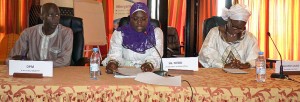
Senegal has adopted a national plan for addressing climate change impacts on marine fisheries. (Credit: USAID/COMFISH)

Senegal has established itself as one of only a few nations to develop a national Climate Change Adaptation Plan specifically for marine fisheries. High-level U.S. and Senegalese government representatives launched the plan in October with the goal of helping the sector and its fisheries communities to cope with the negative impacts of climate change and climate variability.

A partnership of the Ministry of Environment and the Ministry of Fisheries spearheaded the development of this plan with support from USAID, through its fisheries project, USAID/COMFISH, implemented by the Coastal Resources Center at the University of Rhode Island’s Graduate School of Oceanography along with local partners.

Like other key sectors of the Senegalese economy, the fisheries sector is hard hit by climate change. Manifestations of climate change in this sector include changes in fish location and migration patterns, increasing climate variability and number of accidents at sea, coastal erosion affecting fishing communities and landing sites, and flooding.

This national plan is part of a long process that will help the entire fisheries sector in Senegal better adapt to climate change by helping to increase the resilience of coastal/fishing communities. Fisheries play a critical role in the Senegalese economy. This sector involves over 17 percent of the working force, contributes over 2.5 percent to GDP and is one of the main sources of animal protein (over 70 percent) in the diet of the Senegalese people.

Since its inception in 2011, the USAID/COMFISH Project has been working with the Government of Senegal to assess the vulnerability of coastal communities, strengthen the capacity of local actors and institutions in the fisheries and climate change sectors while helping communities plan and undertake proactive adaptation actions to climate change.

Archives

  • February 2019
  • November 2018
  • October 2018
  • September 2018
  • April 2018
  • March 2018
  • February 2018
  • January 2018
  • December 2017
  • November 2017
  • September 2017
  • January 2017
  • November 2016
  • October 2016
  • September 2016
  • August 2016
  • July 2016
  • June 2016
  • May 2016
  • April 2016
  • March 2016
  • February 2016
  • January 2016
  • December 2015
  • September 2015
  • August 2015
  • July 2015
  • June 2015
  • May 2015
  • April 2015
  • March 2015
  • February 2015
  • January 2015
  • December 2014
  • November 2014
  • October 2014
  • September 2014
  • August 2014
  • July 2014
  • June 2014
  • March 2014
  • February 2014
  • January 2014
  • December 2013
  • November 2013
  • October 2013
  • September 2013
  • July 2013
  • June 2013
  • May 2013
  • February 2013
  • December 2012

Meta

  • Log in
CRC-logo
COASTAL RESOURCES CENTER
220 South Ferry Road, Narragansett RI 02882
P (401) 874-6224
E info@crc.uri.edu
THE
UNIVERSITY OF
RHODE ISLAND

Graduate School of
Oceanography
© Copyright 2026 University of Rhode Island.
The University of Rhode Island is an equal opportunity employer committed
to community, equity, and diversity and to the principles of affirmative action.